IGCSE Board Syllabus 2026: Download Cambridge IGCSE curriculum
Table of Contents
The Cambridge IGCSE curriculum offers a variety of routes for learners with a wide range of abilities, including those whose first language is not English. Cambridge International helps schools build a curriculum around their specific needs.
Starting from a foundation of core subjects, it is easy to add breadth and cross-curricular perspectives. Encouraging learners to engage with a variety of subjects and make connections between them is fundamental to our approach. For schools, Cambridge's IGCSE board offers a flexible and stimulating curriculum, supported with excellent resources and training.
For learners, Cambridge IGCSE helps improve performance by developing skills in creative thinking, inquiry, and problem-solving. It is the perfect springboard for advanced study. There are approximately 70 subjects available at Cambridge IGCSE, including 30 languages, and schools can offer them in any combination.
IGCSE Board Syllabus 2026
Cambridge IGCSE develops learner knowledge, understanding, and skills in:
- Subject content
- Applying knowledge and understanding to new as well as unfamiliar situations
- Intellectual inquiry
- Flexibility and responsiveness to change
- Working and communicating in English
- Influencing outcomes
- Cultural awareness
Schools worldwide have been involved in the development of the Cambridge IGCSE. The IGCSE board syllabus 2026 is international in outlook but retains a local relevance. They have been created specifically for an international student body and avoid cultural bias.
Cambridge IGCSE Accounting (0452)
Content overview
1. The fundamentals of accounting
- This section introduces the subject by explaining the difference between bookkeeping and accounting.
- The role of accounting in providing information and the purposes of measuring business profit and loss are also explored. Basic accounting terms and the accounting equation are introduced.
2. Sources and recording of data
- The core topic of this section is the double-entry system of bookkeeping and how this is applied in the preparation of ledger accounts. The division of the ledger is considered.
- Business documents and their use as sources of information are also included. Consideration is given to the procedures for processing information in books of prime entry.
3. Verification of accounting records
This section concentrates on the use of trial balances, bank reconciliation statements, and control accounts as means of verifying accounting records. The procedures for the correction of errors are also covered.
4. Accounting procedures
- Within this section, consideration is given to the importance of distinguishing between capital and revenue expenditure and receipts. Non-current assets are further explored in terms of accounting for depreciation and disposal.
- Procedures to record adjustments for accruals and prepayments, irrecoverable debts, provision of doubtful debts, and the recovery of debts written off are included. Inventory valuation and its impact on financial statements are also covered.
5. Preparation of Financial Statements
- The focus of this section is the preparation of financial statements, including year-end adjustments, for different types of businesses (sole traders, partnerships, and limited companies).
- Consideration is also given to the financial statements of clubs and societies and manufacturing businesses. The procedures employed when only incomplete records are available are also covered.
6. Analysis and Interpretation
- This section introduces the calculation and interpretation of the main accounting ratios. The use of ratios in inter-firm comparison is also included.
- Consideration is also given to the uses of accounting information by interested parties. The limitations of accounting statements are also explored.
7. Accounting Principles and Policies
- The main accounting principles are introduced together with how they are applied in accounting records and statements.
- Consideration is also given to the influence of international accounting standards and the selection of accounting policies
Cambridge IGCSE Biology (9-1) (0970)
Content overview
The Syllabus has been updated. You are strongly advised to read the whole Syllabus before Planning. The Latest Syllabus is version 2, published in February 2019.
Candidates study the following topics:
- 1 Characteristics and classification of living organisms
- 2 The organisation of the organism
- 3 Movement in and out of cells
- 4 Biological molecules
- 5 Enzymes
- 6 Plant nutrition
- 7 Human nutrition
- 8 Transport in plants
- 9 Transport in animals
- 10 Diseases and Immunity
- 11 Gas exchange in humans
- 12 Respiration
- 13 Excretion in humans
- 14 Coordination and response
- 15 Drugs
- 16 Reproduction
- 17 Inheritance
- 18 Variation and selection
- 19 Organisms and their environment
- 20 Biotechnology and genetic engineering
- 21 Human influences on ecosystems
Cambridge IGCSE Business Studies (9-1) (0986)
Content overview
1. Understanding business activity
-
This section introduces the underlying ideas and concepts of business and includes the purpose and nature of business activity and how businesses can be classified.
-
Enterprise and entrepreneurs, and why some businesses grow while others remain small, are further important issues. How business size can be measured, types of business organisation, business objectives, and stakeholder objectives are the concluding topics.
2. People in business
-
The focus is on the functional area of human resources and includes the importance and methods of motivating a workforce. How businesses are organised and managed, and the methods of recruitment, selection, and training of employees, are also considered.
-
Finally, the section covers the importance and methods of effective internal and external communication.
3. Marketing
-
This section includes the role of marketing, the distinctions between niche and mass markets, and the techniques of market segmentation. The methods and importance of market research are covered.
-
The central role of the marketing mix, i.e., the four Ps, is made clear. Marketing strategies to influence consumer decisions at home and in new foreign markets are the final topics in this section.
4. Operations management
- The focus is on the functional area of production and includes the meaning and methods of production and how productivity can be increased. The different costs of production and break-even analysis are covered.
- The section concludes with the importance and methods of achieving quality in the production process and location decisions of businesses.
5. Financial information and decisions
- This finance and accounting section covers the need for and sources of business finance, cash-flow forecasting, and working capital.
- Simple income statements are covered as well as statements of financial position and the analysis of accounts, including why and how accounts are used.
6. External influences on business activity
-
This section focuses on different external influences on business activity and how these impact a business. It includes government influences on economic, environmental, and ethical issues and how they impact the functional areas of businesses.
-
In addition, the international economy, including globalisation and its effects on businesses and governments, multinational businesses, and exchange rates are important issue.
-
Legal constraints are an external influence to be considered, but these influences are covered in the relevant functional areas above, as well as in this last section.
Cambridge IGCSE Chemistry (9-1) 0971
Candidates study the following topics:
- 1. The particulate nature of matter
- 2. Experimental techniques
- 3. Atoms, elements, and compounds
- 4. Stoichiometry
- 5. Electricity and chemistry
- 6. Chemical energetics
- 7. Chemical reactions
- 8. Acids, bases, and salts
- 9. The Periodic Table
- 10. Metals
- 11. Air and water
- 12. Sulfur
- 13. Carbonates
- 14. Organic chemistry
Cambridge IGCSE English - First Language (0500)
Content overview
- Cambridge IGCSE First Language English offers candidates the opportunity to respond with understanding to a rich array of reading texts during the course as a whole. Candidates will use these texts to inform and inspire their own writing and write in a range of text types for different purposes and audiences.
- Candidates will develop both their speaking and their listening skills, delivering a presentation, responding to questions, and engaging in conversations.
- Candidates are encouraged to become appreciative and critical readers, writers, and speakers
and listeners.
Cambridge IGCSE Geography (0460)
The syllabus is divided into three themes:
- Theme 1: Population and settlement
- Theme 2: The natural environment
- Theme 3: Economic development.
The themes are designed to develop an understanding of natural and human environments
Cambridge IGCSE History (0470)
All candidates study all the Core Content in either:
Option A
The nineteenth century: the development of modern nation-states, 1848–1914
The content focuses on the following Key Questions:
• Were the Revolutions of 1848 important?
• How was Italy unified?
• How was Germany unified?
• Why was there a civil war in the United States, and what were its results?
• Why, and with what effects, did Europeans expand their overseas empires in the nineteenth century?
• What caused the First World War?
or
Option B
The twentieth century: international relations since 1919
The content focuses on the following Key Questions:
• Were the peace treaties of 1919–23 fair?
• To what extent was the League of Nations a success?
• Why had international peace collapsed by 1939?
• Who was to blame for the Cold War?
• How effectively did the United States contain the spread of Communism?
• How secure was the USSR’s control over Eastern Europe, 1948–c.1989?
• Why did events in the Gulf matter, c.1970–2000?
In addition, all candidates must also study at least one of the following Depth Studies:
• The First World War, 1914–18
• Germany, 1918–45
• Russia, 1905–41
• The United States, 1919–41
• China, c.1930–c.1990
• South Africa, c.1940–c.1994
• Israelis and Palestinians since 1945
Cambridge IGCSE Mathematics (0580)
Content Overview
Candidates may follow either the Core curriculum or the Extended curriculum. Candidates aiming for grades A* to C should follow the Extended curriculum.
All candidates will study the following topics:
- 1 Number
- 2 Algebra and graphs
- 3 Geometry
- 4 Mensuration
- 5 Coordinate geometry
- 6 Trigonometry
- 7 Matrices and transformations
- 8 Probability
- 9 Statistics
Cambridge IGCSE Physics (0625)
Candidates study the following topics:
- 1. General physics
- 2. Thermal physics
- 3 Properties of waves, including light and sound
- 4 Electricity and magnetism
- 5 Atomic physics
Cambridge IGCSE Physical Education (0413)
Content Overview
-
The syllabus provides candidates with an opportunity to study both the practical and theoretical aspects of Physical Education. It is also designed to foster enjoyment in physical activity.
-
The knowledge gained should enable candidates to develop an understanding of effective and safe physical performance.
Candidates will study all of the following topics:
- 1: Anatomy and physiology
- 2: Health, fitness, and training
- 3: Skill acquisition and psychology
- 4: Social, cultural, and ethical influences
Candidates will also undertake four different physical activities chosen from at least two of the seven categories listed in section 6.2. Physical activities make a significant contribution to syllabus aims and objectives, serving as a source of material to facilitate learning.
Cambridge IGCSE Science - Combined (0653)
Content Overview
- The syllabus content that follows is divided into three sections: Biology (B1–B12), Chemistry (C1–C12), and Physics (P1–P6). Candidates must study all three sections.
- Candidates can either follow the Core syllabus only or they can follow the Extended syllabus, which includes both the Core and the Supplement. Candidates aiming for grades A* to C should follow the Extended syllabus.
- It is important that, throughout this course, teachers should make candidates aware of the relevance of the concepts studied in everyday life, and to the natural and man-made worlds.
Biology
- B1. Characteristics of living organisms
- B2. Cells
- B3. Biological molecules
- B4. Enzymes
- B5. Plant nutrition
- B6. Animal nutrition
- B7. Transport
- B8. Gas exchange and respiration
- B9. Coordination and response
- B10. Reproduction
- B11. Organisms and their environment
- B12. Human influences on ecosystems
Chemistry
- C1. The particulate nature of matter
- C2. Experimental techniques
- C3. Atoms, elements, and compounds
- C4. Stoichiometry
- C5. Electricity and chemistry
- C6. Energy changes in chemical reactions
- C7. Chemical reactions
- C8. Acids, bases, and salts
- C9. The Periodic Table
- C10. Metals
- C11. Air and water
- C12. Organic chemistry
Physics
- P1. Motion
- P2. Work, energy, and power
- P3. Thermal Physics
- P4. Properties of waves, including light and sound
- P5. Electrical quantities
- P6. Electric circuits
Steps to Download the IGCSE Board Syllabus 2026
Candidates can follow the steps given below to download the IGCSE board syllabus 2026 from the official website:
- Step 1: Visit the website- cambridgeinternational.org
- Step 2: Click on the "Programmes and qualifications" section and select "Subjects" (For Cambridge Upper Secondary IGCSE).
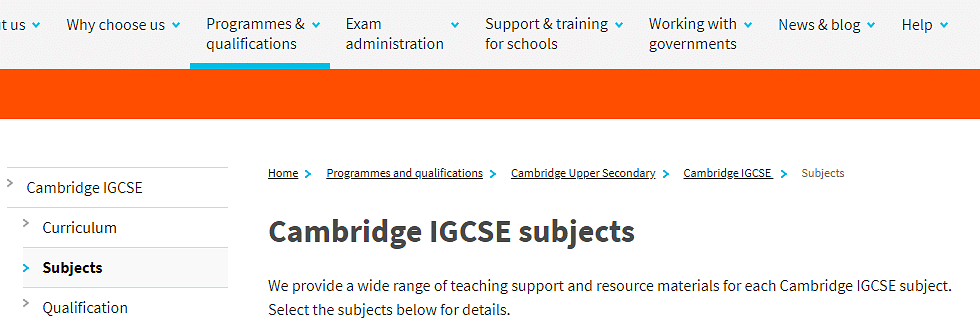
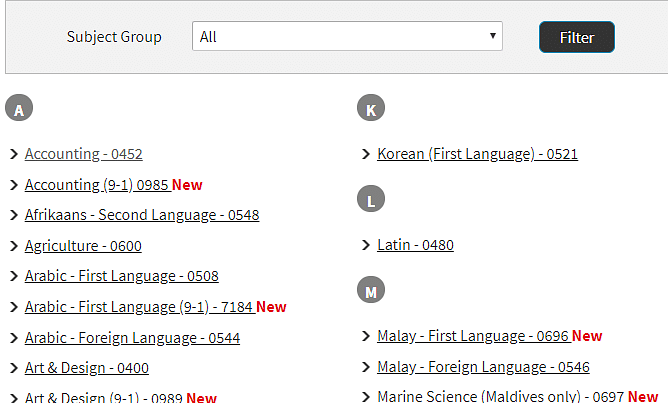
- Step 3: Now, candidates can download the PDF required subject group.
Explore Colleges In India VIEW ALL





![Motilal Nehru National Institute of Technology, [MNNIT] Allahabad](https://media.getmyuni.com/azure/college-image/small/motilal-nehru-national-institute-of-technology-mnnit-allahabad.webp)


Entrance Exams after 12th Boards